
 United States
 Hong Kong
The HKSI Paper 1 pass mark is 70% - 42 questions out of 60
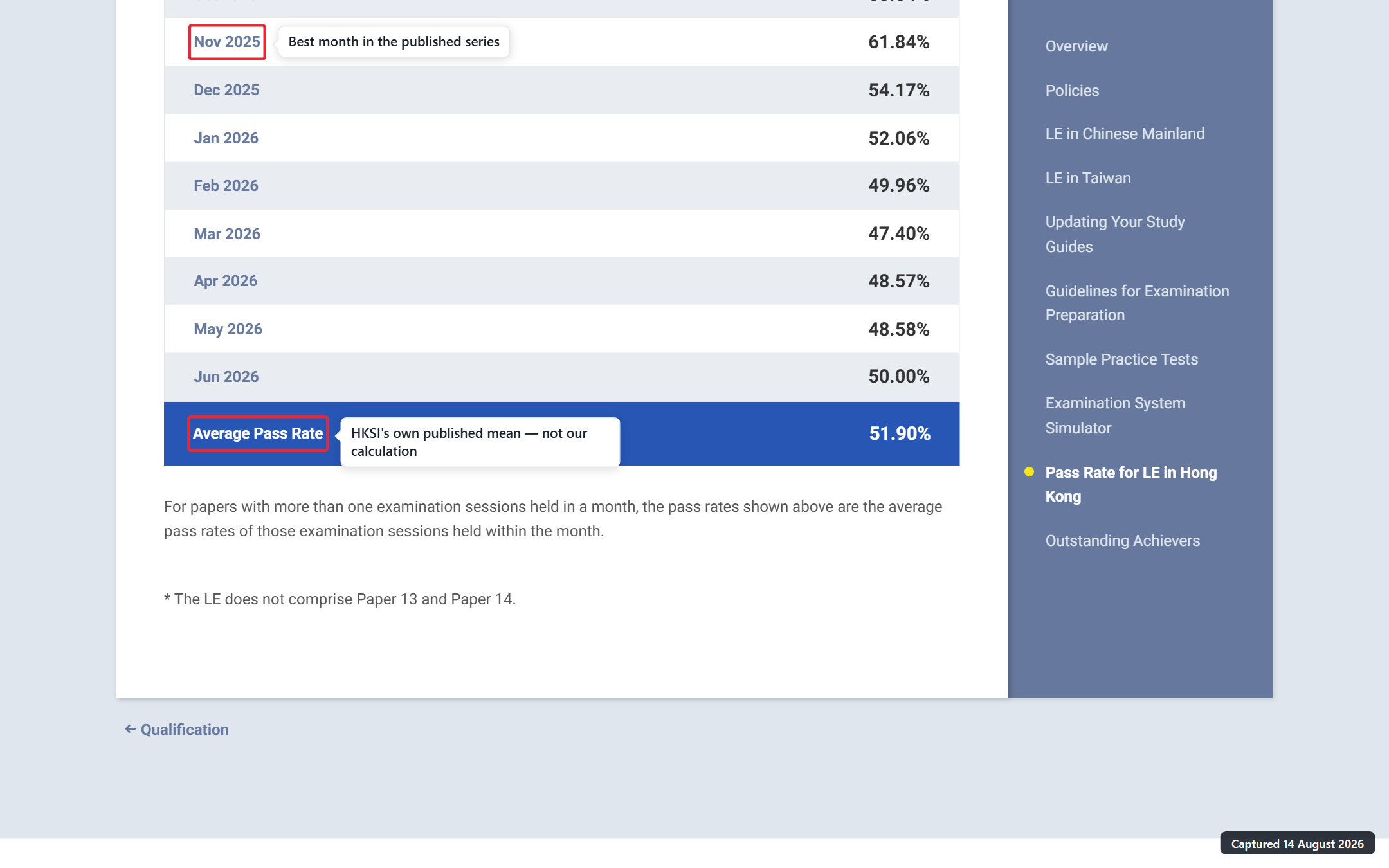
The pass mark for HKSI Paper 1 is 70%, which is 42 correct answers out of 60. It applies to the whole paper, not topic by topic, so you can be wrong eighteen times and still pass. Over the twelve months to June 2026, 51.9% of candidates cleared it.
Seventy per cent sounds severe next to the fifty per cent that gets you through a lot of exams. Translate it into questions and it changes character: 42 right out of 60, which means eighteen wrong answers and you still walk out with a pass. That is the number to hold in your head, because it is the one that tells you when to stop studying.
The standard
- Pass mark
- 70%
- Questions to pass
- 42 of 60
- Questions you can get wrong
- Eighteen
- Applied
- To the whole paper, not per topic
- Question type
- Multiple choice
- Time
- 90 minutes
- Twelve-month mean pass rate
- 51.9%, to June 2026
- Fee per attempt
- HKD 1,800
There is no topic-by-topic hurdle
This matters more than most candidates realise. Some professional examinations require a minimum in each section as well as an overall pass, which forces you to shore up your worst area regardless of your strongest. Paper 1 does not work that way. The 70% is a single figure across all sixty questions, so a strong Topic 3 can carry a weak Topic 8.
That has a strategic consequence. Marginal study time is best spent wherever it buys the most marks, not wherever you feel most exposed. And because HKSI does not publish how many questions come from each topic, "where the marks are" is a judgement rather than a calculation - our own estimate of the topic split is exactly that, an estimate.
What the pass mark does not tell you
Whether any adjustment is applied to raw scores. We have found no published rule that deducts marks for wrong answers, and the standard is expressed as a count of correct answers: 42 of 60. If that ever matters to your strategy, the current Examination Handbook is where HKSI sets out its marking arrangements, and it takes five minutes to read.
The practical instruction is the same in every case. Answer all sixty questions. A blank answer is a guaranteed zero and a guess is not.
With no knowledge at all, a guess is still better than a blank. With the list narrowed to two, a guess is a coin flip on a question you have already half-solved. Never leave the paper with an unanswered question, however little time you have left.
The score to aim for in practice
Not 42. Aim higher, and here is why.
| Your honest timed mock score | What it means | What to do |
|---|---|---|
| Below 30 of 60 | Not close. Coverage problem, not a technique problem | Go back to the syllabus and audit what you have actually studied |
| 30 to 40 | Real progress, not enough margin | More questions, and rework what you get wrong |
| 42 to 45 | At the standard, with no room | You could pass. You could also not. Push for margin |
| Above 45 | Comfortable | Book it, or sit it if it is booked |
| Above 50 | You are over-preparing | Sit the exam and get on with your second paper |
Here is the opinion. The right target is the high forties out of 60 on honest timed practice, and the reason is variance rather than nerves. Sixty questions is a small sample of a syllabus with sixty-six second-level headings. A candidate whose true ability sits at exactly 70% will fail a meaningful fraction of the time simply because of which questions came up. Margin is not vanity, it is insurance against the draw.
The published monthly rates support that reading. They range from 47.4% in March 2026 to 61.84% in November 2025 across the sittings HKSI has published, which is a wide spread for the same exam against the same standard.
The word "honest" is doing work in that table
A practice score only means something if the conditions match the exam. Closed book. Ninety minutes on a clock you cannot pause. Sixty questions in one sitting, not thirty on Tuesday and thirty on Thursday. No looking anything up mid-attempt, however tempting.
Scores from untimed, open-book, interrupted practice are systematically inflated, usually by enough to turn a fail into an apparent pass. Candidates who fail while "scoring in the fifties at home" almost always scored those fifties under conditions the exam does not offer. Sit at least one full 60-question mock properly before you decide you are ready.
Why 70% rather than something lower
Because of what the qualification is for. A pass tells the SFC that a person carrying on a regulated activity understands the framework they operate in, and a bar set at half the paper would tell the regulator very little. Seventy per cent on a broad, factual, closed-book paper is a defensible statement that you know most of the syllabus rather than the parts you liked.
The concession: 70% is high enough that the exam catches people who genuinely would be competent practitioners. Some of the 48.1% who do not pass know the job better than some of the people who do. The exam measures recall of a regulatory framework under time pressure, and that correlates with competence without being the same thing. Knowing that is oddly useful after a fail - the retake page picks up from there.
Common questions
What is the pass mark for HKSI Paper 1?
Seventy per cent, which is 42 correct answers out of 60 questions. The mark applies across the whole paper rather than topic by topic, so you can be wrong on eighteen questions and still pass, regardless of which topics those questions came from.
How many questions can I get wrong?
Eighteen. With 60 questions and a 70% pass mark, 42 correct clears the bar. That is a useful reframing, because 70% sounds punishing while eighteen wrong answers sounds like the ordinary margin of a well-prepared candidate.
Do I need to pass each topic separately?
No. There is no per-topic hurdle. A single overall score of 42 of 60 passes the paper, so strength in one topic can offset weakness in another. That said, with nine topics and only 60 questions, ignoring a topic entirely is still a poor bet.
Is the pass mark scaled or curved?
The standard is published as 70%, expressed as 42 of 60. HKSI sets out its marking arrangements in the Examination Handbook, and that is where to confirm anything about how raw scores are treated. In practice, prepare as though every question counts equally.
What score should I be getting in practice?
Aim for the high forties out of 60 on genuinely timed, closed-book mocks rather than exactly 42. Sixty questions is a small sample, and a candidate whose true standard is 70% will fail some sittings purely on which questions came up.