
 United States
 Hong Kong
The HKSI Paper 1 pass rate, and what it actually tells you
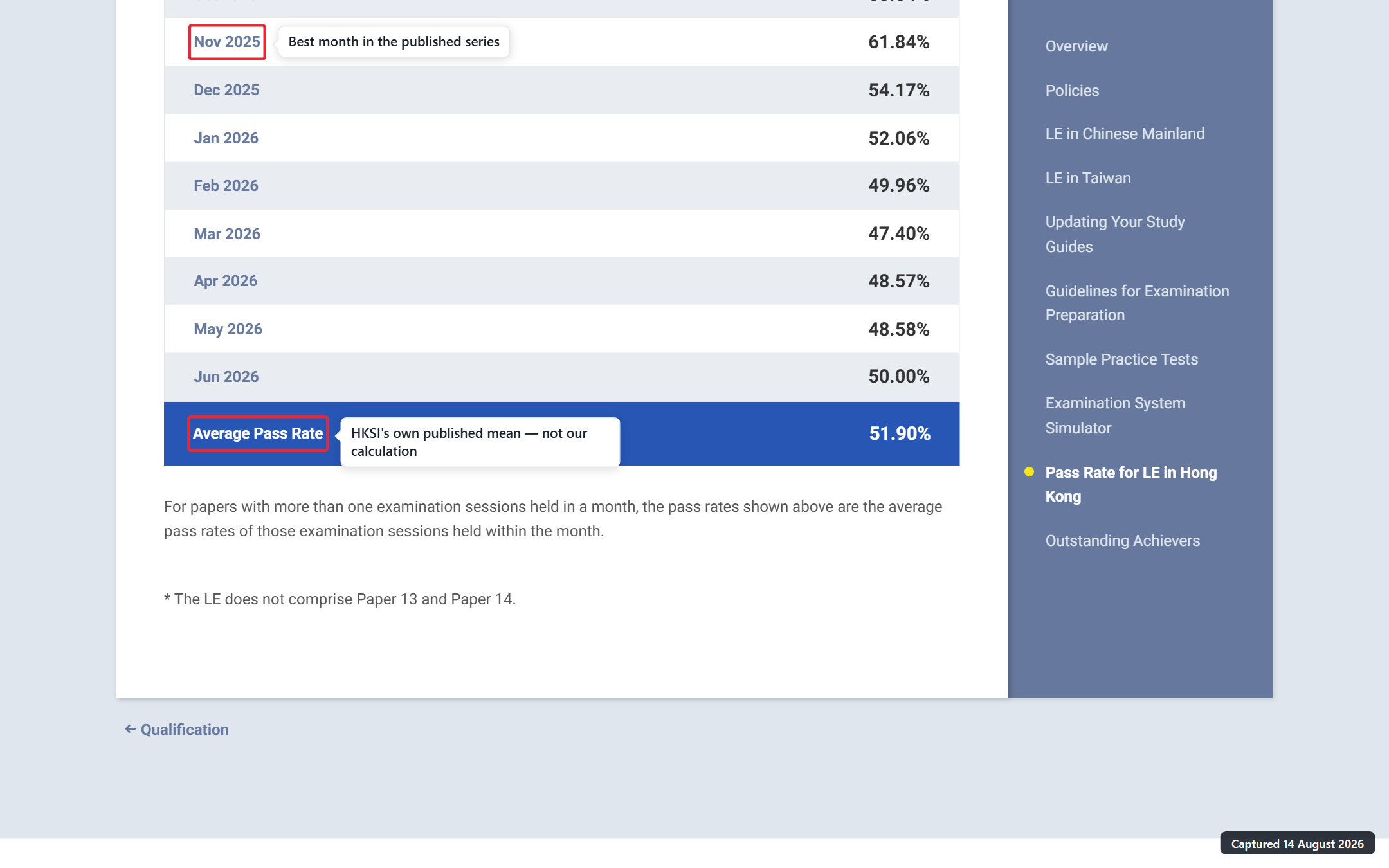
The twelve-month mean pass rate for HKSI Paper 1 to June 2026 was 51.9%, so about 48.1% of candidates fail. Published monthly figures ran from 47.4% in March 2026 up to 61.84% in November 2025. HKSI publishes the rate but never the candidate count.
Half. That is the number to hold in your head before you plan anything, because the twelve-month mean pass rate to June 2026 was 51.9%, and a coin flip is a poor thing to walk into with three evenings of revision behind you.
HKSI Institute publishes the rate for each sitting on its own website. It does not publish how many people sat, which changes how much weight any single month can carry. Below is every figure we have been able to verify, the mean, and an honest read of the movement between months.
- Pass mark
- 70% - 42 of 60 questions
- Twelve-month mean
- 51.9% for the twelve months to June 2026
- Implied fail rate
- About 48.1%
- Highest published month
- 61.84%, November 2025
- Lowest published month
- 47.4%, March 2026
- Candidate numbers
- Not published by HKSI
- Source checked
- 9 August 2026
What is the published HKSI Paper 1 pass rate for each month?
These are the sittings we can point at a published figure for. We have deliberately not filled the gaps. If a month is missing from this table it is because we could not verify a rate for it, and inventing one to make the series look tidy would defeat the point of the table.
| Sitting | Published pass rate |
|---|---|
| September 2025 | 56.19% |
| November 2025 | 61.84% |
| February 2026 | 49.96% |
| March 2026 | 47.4% |
| June 2026 | 50% |
| Twelve-month mean to June 2026 | 51.9% |
Why does the pass rate move so much between months?
The spread here is about fourteen points, top to bottom. That is a lot for an exam with a fixed pass mark and a stable syllabus, and it is worth being precise about what could cause it rather than hand-waving at "harder papers".
Three things move a rate like this. The composition of the cohort, first: a month that catches the post-graduation intake looks different from a month full of second attempts. The paper itself, second - item difficulty is calibrated but not identical across forms. And plain small-sample noise, third, which we cannot size because the denominator is not published.
That last point matters more than the other two. If a sitting had a few hundred candidates, a swing of several points is unremarkable statistical wobble. If it had several thousand, the same swing is a real signal. We do not know which, so we will not pretend the November 2025 figure of 61.84% represents an easier paper. It might. It might also be the same paper and a stronger room.
Split the twelve sittings at 1 January 2026, the date the v3.4.2 syllabus took effect, and they fall six either side. The 2025 half averaged 54.36%. The 2026 half averaged 49.43%. Every month from February onward sits below the twelve-month mean. That is a cleaner pattern than we expected to find, and it still is not proof of anything: HKSI publishes no candidate numbers, so a change in who is sitting the paper would leave exactly the same trace as a change in the paper.
How many people sit HKSI Paper 1 each year?
Nobody outside the Institute knows. HKSI publishes rates and not volumes, and there is no regulatory filing that discloses candidate numbers for a single paper. We mention this because you will find sites quoting annual candidate counts with real confidence, and none of them show a source. Ours is the boring answer, but it is the correct one.
The practical consequence: nobody can tell you how many people pass in absolute terms, and any "X thousand candidates a year" claim you read is somebody's guess wearing a suit.
Is 51.9% a hard exam or an easy one?
It is a middling number that describes a soft exam taken by unprepared people. The content is not conceptually difficult - there is no maths beyond arithmetic, no modelling, nothing you would call analytically demanding. What there is, is volume: nine topics, 66 second-level syllabus headings, and a pass mark set at 70% rather than the 50% or 60% that flatters most professional papers.
You need 42 right. Most failures we see described are not conceptual failures at all. They are recall failures on Topic 3 and Topic 4 - the Ordinance and the licensing and subsidiary legislation material - where the answer turns on which regime applies rather than on understanding anything.
Our opinion, plainly: the 70% pass mark is doing more work in that 51.9% than the difficulty of the material is. Drop the threshold to 60% and this exam would have a pass rate in the seventies overnight. That is not a criticism of HKSI - a licensing gate should be a gate - but it should change how you prepare. You are not studying to understand. You are studying to be reliably right about details you find dull.
What actually separates the half that passes?
- They finished the syllabus. All nine topics, not seven and a hope. The paper samples across everything, so an untouched topic is a guaranteed hole.
- They sat timed practice. Ninety minutes for 60 questions is 1.5 minutes each, and people who have never practiced against the clock lose marks to rushing at the end rather than to ignorance.
- They treated Topic 3 as a structure problem, not a memorising problem. Knowing which Part of the Ordinance a subject lives in beats reciting text you half-remember.
- They knew the boundary cases. Client money against client securities. Which activity needs which licence. Where the codes bite and where the Ordinance does.
The concession: none of that is derived from candidate-level data, because no such data is published. It comes from the syllabus structure and from what people who have failed tell us they got wrong. Treat it as an informed read, not as a finding.
If you want to know where you sit against that 70% line right now, the honest way is a timed run at a full set of Paper 1 practice questions rather than a feeling about how the reading is going.
Common questions
What is the current HKSI Paper 1 pass rate?
The twelve-month mean to June 2026 was 51.9%, published by the HKSI Institute. Individual sittings in that window ranged from 47.4% in March 2026 to 61.84% in November 2025. The figure moves month to month, so the mean is the more useful headline for planning.
What percentage of candidates fail HKSI Paper 1?
About 48.1%, taking the twelve-month mean to June 2026 as the baseline. That is close to half. It is also why a resit at HKD 1,800 is a real budget item rather than a remote possibility, and worth pricing in before you book.
Does HKSI publish how many people sit Paper 1?
No. HKSI publishes the pass rate for each sitting but not the number of candidates behind it. Any annual candidate figure you see quoted elsewhere is an estimate without a public source, and we do not repeat figures we cannot point at.
Is the pass rate different for the Chinese-language paper?
HKSI publishes a single rate per sitting, not a split by language. Paper 1 is offered in English and Traditional Chinese, but no separate pass rate for each version is published, so nobody can honestly say one version is easier.
Has the Paper 1 pass rate been falling?
The six sittings after the v3.4.2 syllabus took effect averaged 49.43%, against 54.36% for the six before it. So yes, the recent run is worse, by about five points. Whether the paper got harder or the candidate mix changed is not something anyone outside HKSI can tell, because candidate numbers are not published.