
 United States
 Hong Kong
HKSI Paper 1 pass rate by month: is there a good month to sit?
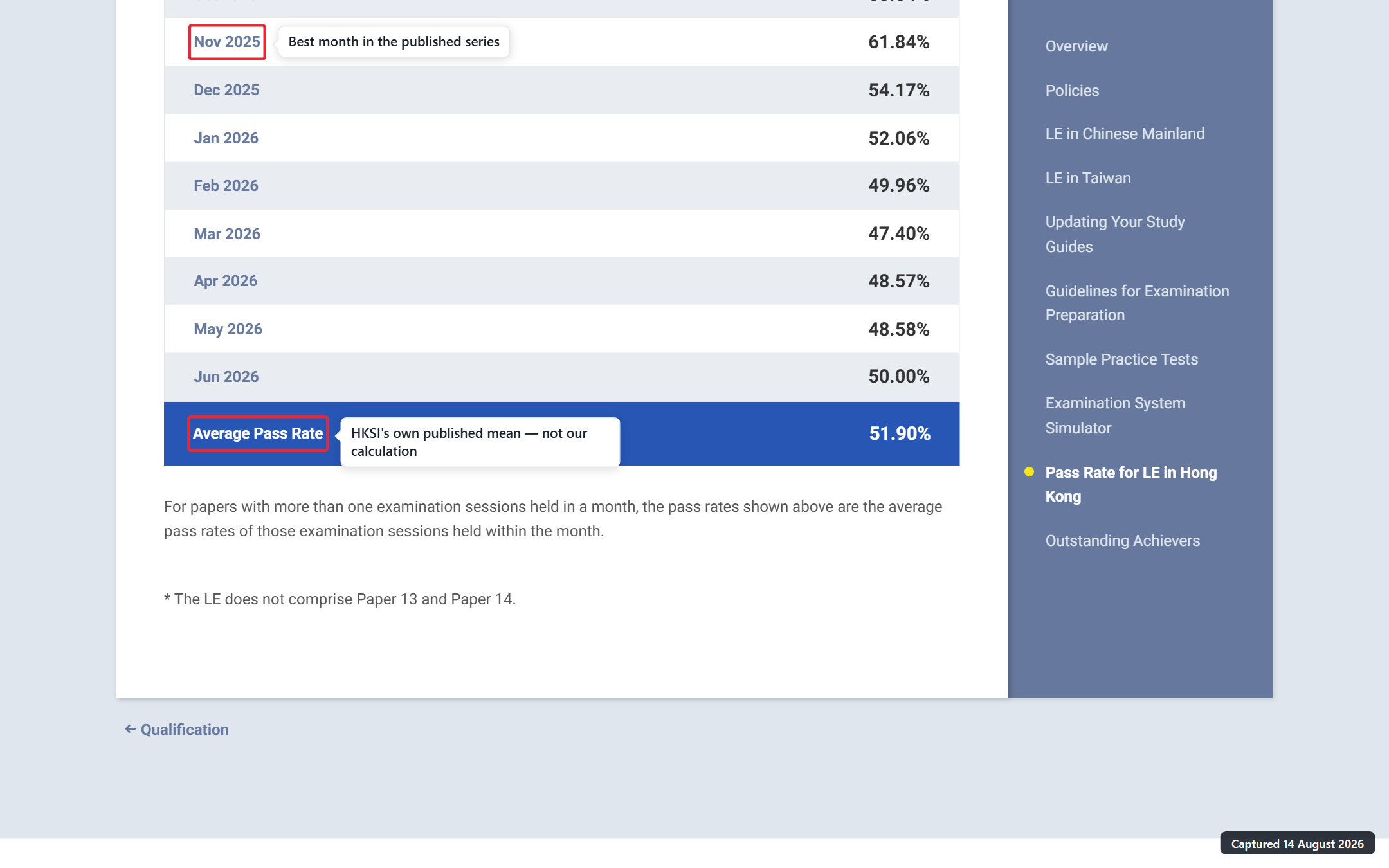
Published monthly rates range from 47.4% in March 2026 to 61.84% in November 2025, against a twelve-month mean of 51.9% to June 2026. There is no reliable good month. Without published candidate numbers, the month-to-month spread cannot be separated from ordinary sampling noise.
People ask this question hoping for an edge. Sit in November, the theory goes, because November looked easy. We understand the impulse and we think it is a bad basis for a decision, but the data is worth laying out properly because the spread in it is genuinely large.
The published rates, month by month
| Sitting | Published pass rate | Against the twelve-month mean |
|---|---|---|
| September 2025 | 56.19% | Above |
| November 2025 | 61.84% | Well above |
| February 2026 | 49.96% | Below |
| March 2026 | 47.4% | Well below |
| June 2026 | 50% | Below |
| Twelve-month mean to June 2026 | 51.9% | - |
Those are the sittings we can point at a published figure for as at 9 August 2026. Months not listed are months we could not verify, not months with no exam - Paper 1 runs monthly at HKSI examination centres in Hong Kong. We have left the gaps visible rather than smoothing them, because a filled-in series would imply a precision we do not have.
Is there a seasonal pattern?
Nothing you should trade on.
There is a story you could tell from these numbers. Autumn sittings look strong, spring sittings look weak, and you could rationalise that with a cohort argument: graduates hired in the summer sit in the autumn after a training programme, while the spring intake is thinner and more self-directed. It sounds plausible. It is also exactly the kind of narrative that fits five data points and then dissolves when the sixth arrives.
The stronger reading is simpler. September and November 2025 were both above the mean, February, March and June 2026 were all below it. That is not seasonality - that is two calendar years behaving differently, and the syllabus changed to v3.4.2 with effect from 1 January 2026, which sits neatly on the boundary. Neat enough to be suspicious of, in fact. Correlation with one event that happens to fall on a year boundary is very weak evidence.
Why the monthly numbers cannot settle the question
HKSI publishes the rate. It does not publish how many people sat. Without a denominator, a swing from 61.84% to 47.4% could be a meaningful change in paper difficulty, or it could be the entirely ordinary variation you get from small cohorts. There is no way to tell from outside, and any site that tells you which one it is has not thought about it.
We do not know how many people sit Paper 1 each month, each year, or in total. HKSI publishes pass rates but not candidate numbers, and we will not repeat a figure we cannot source. It limits what we can conclude, and we would rather say so than manufacture confidence.
What the monthly data is genuinely useful for
- Calibrating expectations. Every published month sits between 47.4% and 61.84%. Not one is anywhere near eighty per cent. This is not an exam most people walk through.
- Budgeting. At an implied fail rate near 48.1%, treat the HKD 1,800 fee as something with a real chance of being paid twice.
- Sanity-checking claims. If a course provider quotes you a pass rate wildly above these numbers for its own students, ask how they know - they would need every student to report back.
So when should you sit?
When you are ready, which for most people means six to eight weeks after starting properly. Picking a month by its historical rate optimises a variable worth a few percentage points, at best, and probably worth nothing. Your own preparation moves your personal probability by far more than the choice of sitting does.
Our opinion: the search for a soft month is a form of procrastination. It feels like strategy. It is a fortnight of not reading Topic 3.
The concession is that we would say something different if we had ten years of monthly data and candidate counts. A genuine seasonal effect in a licensing exam is not absurd - cohort composition really does shift with hiring cycles. We just cannot see it in what is published, and neither can anyone else.
If you want the fuller analysis of the movement in these numbers rather than the month-picking question, see our trend analysis of the Paper 1 pass rate.
Common questions
Which month has the highest HKSI Paper 1 pass rate?
Of the sittings we can verify, November 2025 at 61.84% is the highest, and March 2026 at 47.4% the lowest. The gap is wide, but with no published candidate numbers there is no way to establish whether it reflects paper difficulty or ordinary variation.
Are some HKSI sittings easier than others?
Nothing in the published data proves it either way. Item difficulty is calibrated across forms, and the published rate is influenced by who sits as much as by what is on the paper. Choose your sitting by when your preparation will be finished.
How often is HKSI Paper 1 held?
Monthly, at HKSI Institute examination centres in Hong Kong. That cadence is one of the exam's real advantages: a failed attempt costs HKD 1,800 and a few weeks rather than waiting for an annual or biannual window.
Does HKSI publish pass rates for every month?
The Institute publishes rates on its pass-rate page, but not every sitting has a figure we could verify at the time of checking. We list only the months we could confirm, last checked on 9 August 2026, rather than interpolating the gaps.
Has the pass rate dropped since the new syllabus?
The sittings we can verify in 2026 all fall below the two we can verify in 2025, and syllabus v3.4.2 took effect on 1 January 2026. That is suggestive and nothing more. Five data points spanning a version change cannot establish causation.