
 United States
 Hong Kong
Retaking HKSI Paper 1: the rules, the cost, and how to not fail twice
A Paper 1 retake is a fresh enrolment at the full HKD 1,800 fee, sat at a later monthly sitting against the same 70% standard of 42 of 60. HKSI publishes any limits or waiting periods on attempts, so check its current rules. Rebooking fast and studying the same way is the common mistake.
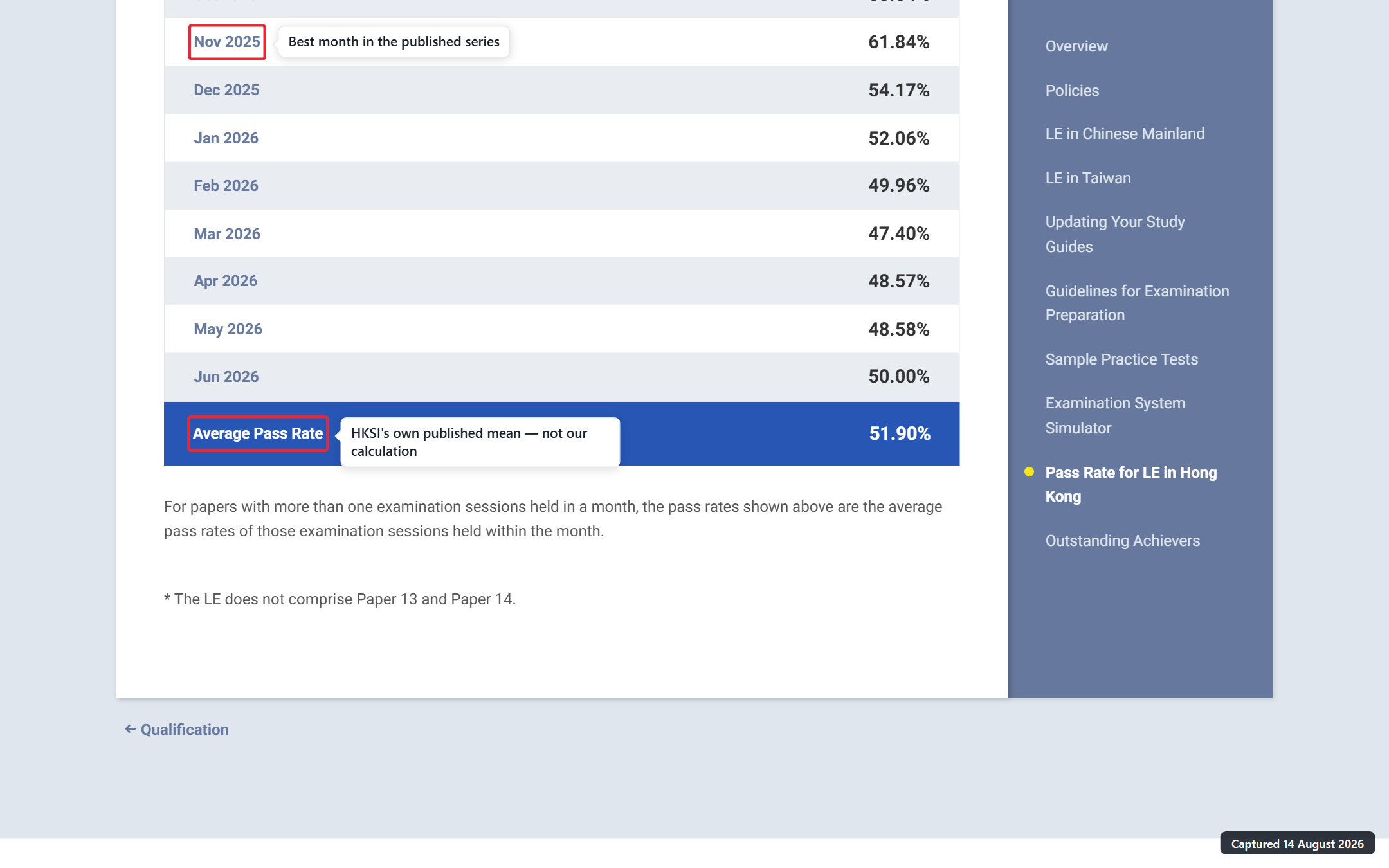
About half the room does not pass. The twelve-month mean to June 2026 was 51.9%, which puts the failure rate near 48.1%, so a fail puts you in a very large and very ordinary group. What separates the people who clear it on the second attempt from the people who are still going on the fourth is not ability. It is whether they changed anything.
The mechanics of a resit
A retake is not a special process. You enrol again, in the same system, for a later sitting, and you pay again.
- Resit fee
- HKD 1,800 - the full fee, every attempt
- Standard
- Unchanged: 70%, or 42 of 60
- Format
- Unchanged: 60 questions, 90 minutes, closed book
- Sittings
- Monthly, in Hong Kong
- Attempt limits or waiting periods
- Set and published by HKSI - check the current rules
- Does a partial result carry over?
- No. Each sitting is scored on its own
Whether HKSI caps the number of attempts, and whether it imposes a wait between them, is the Institute's rule to set and publish. We will not print a number we cannot source. Read the current Examination Handbook and the enrolment page before you plan a resit date, because this is exactly the detail that would wreck a schedule if it were wrong.
Diagnose before you rebook
This is the whole game, and almost nobody does it. Your result will not tell you why you failed, so you have to reconstruct it while the sitting is fresh. Sit down within a couple of days and answer one question honestly: what was the failure mode?
| Failure mode | The tell | The fix |
|---|---|---|
| Ran out of time | Last ten questions rushed or blank | Timed full-length mocks. Nothing else fixes pacing |
| Recognition, not recall | Options looked familiar, you still guessed | Close the book. Self-test out loud. Stop re-reading |
| Coverage gap | A block of questions on a topic you skimmed | Audit yourself against all 66 syllabus headings |
| Near-neighbour confusion | Down to two options every time, wrong half of them | Comparison tables: which body, which code, which Part |
| Not enough hours | You know | A dated schedule, not good intentions |
Most people who fail land in the second or fourth row. They understood the material perfectly well reading it, and the exam asked them to produce it from nothing, in ninety minutes, against four options engineered to be confusable. That is a different skill from comprehension, and it is trainable.
How long to wait
Long enough to change something. Short enough that the material is still warm. In practice that usually means one sitting cycle rather than the next available one, though the right answer depends entirely on which row of the table above you fell into.
If you ran out of time, you could be ready in two weeks, because pacing is a technique problem and technique fixes fast. If you had a coverage gap across two or three topics, you need real study weeks and rushing back in is throwing HKD 1,800 at the same outcome. The study-time estimates are a reasonable starting point for the second attempt too.
What to change, specifically
Reading the manual again is not a plan. It is the thing you already did. Three changes are worth more than another pass through the material.
- Move from input to output. Your second attempt should be mostly questions, not mostly reading. If your first attempt was four parts reading to one part questions, invert the ratio.
- Score against 42, always. Every practice session gets a score out of 60 and a comparison to the pass standard. Vague confidence is what got most people here.
- Build the confusion tables yourself. Writing out which body does what, which code applies to which business, and which Part of the Ordinance covers which subject is worth more than reading somebody else's version of the same table.
Here is the opinion, stated plainly because it is the reason this page exists: after a failed attempt, unstructured re-reading has close to zero expected value, and the reason candidates keep doing it is that it feels productive and questions feel painful. Getting questions wrong in practice is the entire mechanism by which you stop getting them wrong in the exam. Sit the practice questions badly, on purpose, early.
The money, honestly
Each attempt is HKD 1,800. Two attempts is nearly three thousand Hong Kong dollars of examination fee, before you count the delay to a start date or a promotion. That is the frame in which to judge whether to spend anything on preparation for the second attempt - the comparison is not against zero, it is against another failed sitting.
The concession: some people genuinely do fail once through bad luck. Sixty questions is a small sample, the monthly pass rate has swung from 47.4% to 61.84% across the sittings HKSI publishes, and a candidate sitting at a true standard of around 70% will fail sometimes for no better reason than which questions came up. If you were scoring in the low forties on honest timed mocks and you failed, you do not need a new strategy. You need a slightly bigger margin.
What a fail does not affect
A failed attempt is not a regulatory black mark. It is not a fitness and properness issue, it does not appear on the SFC public register, and it does not follow you around. Firms fund resits routinely because they know the pass rate. Tell your compliance team, book properly, and move on.
Common questions
How many times can you retake HKSI Paper 1?
Any cap on attempts is set by the HKSI Institute and published in its current examination rules. We will not quote a number we cannot source. Check the Examination Handbook before you plan a sequence of sittings, because the answer would materially change your timetable.
How much does it cost to retake HKSI Paper 1?
HKD 1,800, the same as the first attempt. There is no discounted resit. Two attempts therefore cost the fee twice over, which is the number to weigh against spending on preparation rather than comparing preparation costs to zero.
How soon can I resit after failing?
Sittings run monthly, and any waiting period between attempts is HKSI's rule to publish. Availability is rarely the real constraint. Being ready is. If your failure was a coverage gap rather than a pacing problem, the next sitting is usually too soon.
Does a failed attempt show up anywhere?
No. A fail is not a regulatory matter, it does not appear on the SFC public register, and it is not a fitness and properness concern. With roughly 48.1% of candidates not passing, compliance teams treat resits as routine and often fund them.
Do I have to restudy everything for the resit?
No, and doing so is usually a mistake. Rework the topics you could not produce under pressure, and spend the rest of your time on timed questions. Another linear read of the material is the approach that already failed once.