
 United States
 Hong Kong
Is the HKSI Paper 1 pass rate falling? A careful look
HKSI's twelve published sittings split evenly across the syllabus change: the six months to December 2025 averaged 54.36%, the six to June 2026 averaged 49.43%. A gap of 4.93 points, with the v3.4.2 syllabus landing on 1 January 2026. That is a real pattern. It is still six sittings a side, with no candidate numbers behind them.
There is a pattern in the published numbers and it is not subtle. Every sitting we can verify in 2026 came in below every sitting we can verify in 2025. If you saw that in a business report you would call it a trend and start writing recommendations. We are going to argue against doing that, and then explain what would change our minds.
The series
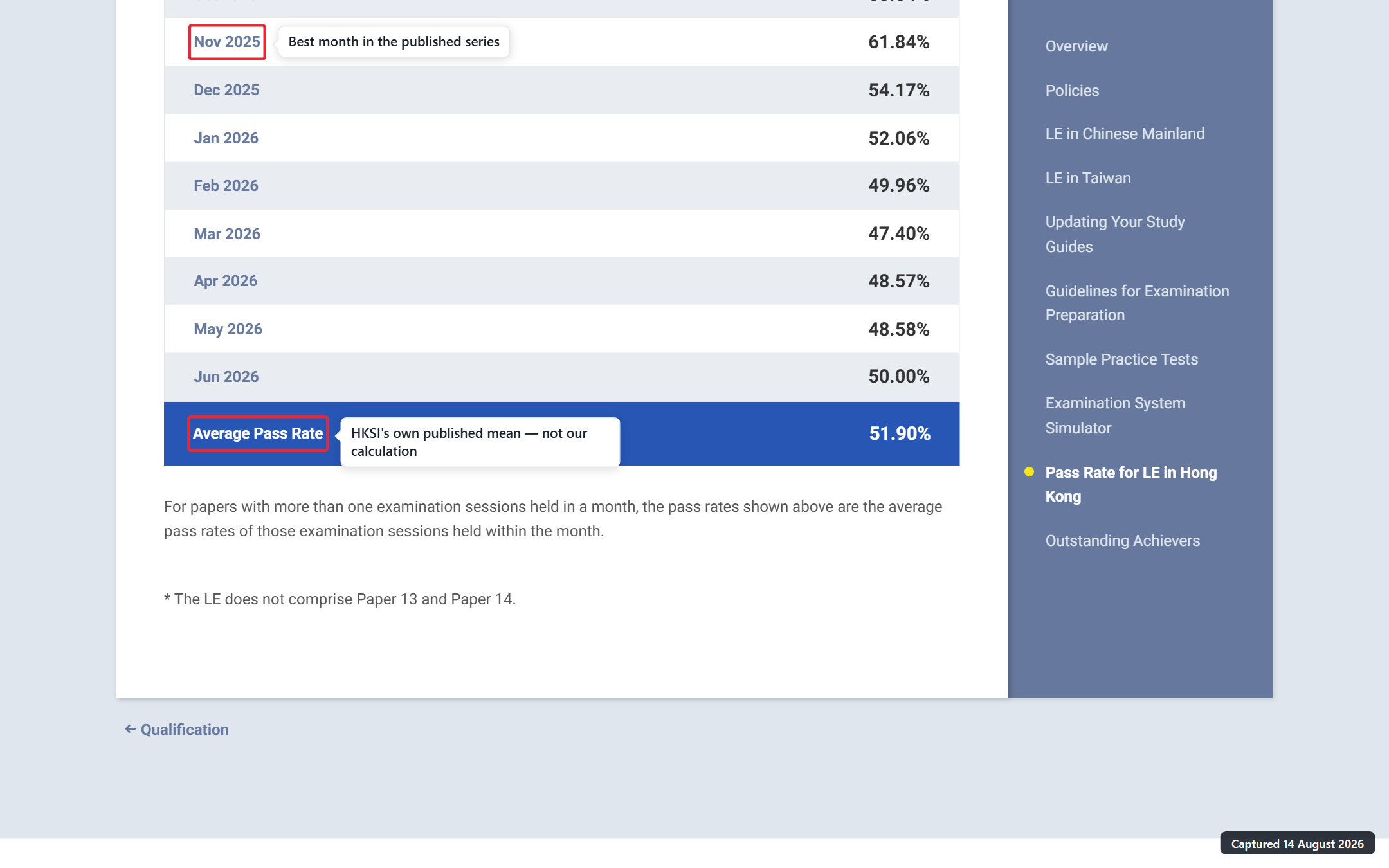
| Sitting | Pass rate | Position |
|---|---|---|
| September 2025 | 56.19% | Above the twelve-month mean |
| November 2025 | 61.84% | Highest verified figure |
| February 2026 | 49.96% | Below the mean |
| March 2026 | 47.4% | Lowest verified figure |
| June 2026 | 50% | Below the mean |
| Twelve-month mean to June 2026 | 51.9% | The reference line |
Verified against the HKSI Institute pass-rate page on 9 August 2026. Months absent from this table are months we could not confirm a figure for, not months without an exam - Paper 1 runs monthly. We have not interpolated the gaps and we would treat any site that does with suspicion.
Why five points cannot establish a trend
Three separate problems, each sufficient on its own.
No denominator. HKSI publishes the rate and never the number of candidates. Without knowing how many people sat, there is no way to attach a margin of error to any figure. A sitting with a small cohort can move several points on noise alone, and the gap between 61.84% and 47.4% may be well inside the range you would expect from ordinary variation. Or it may not. That is precisely the problem - the published data cannot distinguish the two.
Gaps in the series. We have five verified sittings across a monthly exam. The unverified months are not random with respect to anything we can check, and a partial series can manufacture a slope that the full series would not show.
A confounder sitting exactly on the break. Syllabus v3.4.2 took effect on 1 January 2026, which is the same boundary the apparent decline falls on. That is either the explanation or a coincidence, and with two sittings on one side and three on the other, no analysis can tell you which.
Candidate counts per sitting, a complete monthly series across at least two years, and ideally a split between first attempts and resits. HKSI publishes none of those. Until that changes, the twelve-month mean of 51.9% is the most reliable single number available, and month-level readings are decoration.
The syllabus hypothesis, taken seriously
It deserves better than a dismissal. Syllabus revisions genuinely can depress pass rates for a period, and the mechanism is not mysterious: study materials lag the revision, candidates prepare from notes written against the old structure, and question banks circulating informally go stale. That effect is real and it is temporary, typically fading as materials catch up.
If that is what is happening here, the rate should recover across late 2026 as materials align with v3.4.2. If the 2026 figures hold below the mean into next year, something more structural is going on - a genuine recalibration of item difficulty, or a shift in who is sitting. We will keep updating this page either way, and we will say plainly if we were wrong.
How we maintain this series
Three rules, so you can judge the page rather than trust it. We record a figure only when we can see it published by the Institute, and we date the check - these were verified on 9 August 2026. We do not interpolate missing sittings, average across gaps, or restate a figure at a precision it was not published at. And when a new sitting changes the reading, we change the reading rather than quietly leaving the old conclusion up.
That is a boring methodology. It is also the reason this table is short.
What this means for you, practically
- Prepare to the twelve-month mean, not to the best month. Assuming 61.84% conditions is planning for the most favourable observation in the series, which is not planning.
- Check the syllabus version on every set of notes you use. v3.4.2 took effect on 1 January 2026 and v3.5 has since replaced it, so the syllabus has moved twice inside the window this analysis covers. Material written before either change is the one concrete risk here.
- Do not pick your sitting month from this table. The variation is not reliably attributable to anything you can exploit.
- Budget for the resit fee of HKD 1,800. At an implied fail rate near 48.1%, that is prudence rather than pessimism.
Our opinion: the apparent decline is more likely a materials-lag effect than a harder exam, and we would put a fair amount of weight on that reading - the timing fits, the mechanism is well understood, and nothing else changed on 1 January 2026 that we can identify. But we hold it loosely, because five points is five points.
The concession, which is the real point of this page: we would rather publish an honest "we cannot tell" than a confident narrative. Most sites will show you a downward line and an explanation. The line is real. The explanation is not available in the data, and anyone offering one has stopped doing analysis and started doing content.
For the full table with the source and verification date, see our main Paper 1 pass rate page. For the month-picking question specifically, see pass rate by month.
Common questions
Is the HKSI Paper 1 pass rate falling?
Five of the six 2026 sittings came in below the twelve-month mean, and the half-year averages differ by 4.93 points either side of the syllabus change. That is more than noise. What it is not is proof of cause: HKSI publishes no candidate numbers, so a shift in who sat the paper would look identical to a shift in how hard it was.
Did the new syllabus make Paper 1 harder?
Unproven, and plausible for an indirect reason. Syllabus v3.4.2 took effect on 1 January 2026, and revisions typically depress rates briefly while study materials catch up rather than because the paper itself became harder. If that is the cause, the rate should recover.
What is the most reliable pass rate figure to use?
The twelve-month mean of 51.9% to June 2026. Individual monthly figures swing widely - from 47.4% to 61.84% in the verified series - and without candidate numbers there is no way to tell signal from noise at the month level.
Why does HKSI not publish candidate numbers?
We do not know its reasoning, and we will not speculate about it. What matters practically is the consequence: without a denominator, no external analysis can put error bars on a monthly rate, so month-to-month comparisons carry much less weight than they appear to.
How often do you update this analysis?
We recheck the HKSI pass-rate page and restate the verification date whenever we revise the page; the figures here were checked on 9 August 2026. If new sittings change the picture, we will update the reading rather than defend the earlier one.