
 United States
 Hong Kong
What a Good CFP Practice Question Looks Like
A strong late-stage CFP practice question presents client facts that change the recommendation, offers plausible choices, and explains why the tempting alternative loses on those facts.
- Short recall checks still have a place while learning a concept.
On this page6 sections
A bank can feel difficult because it asks obscure facts, or because it makes you weigh a client's competing needs. Those are different skills. A good late-stage CFP bank spends enough time on the second one. Use the questions and the explanations, not just the marketing page, to judge it.
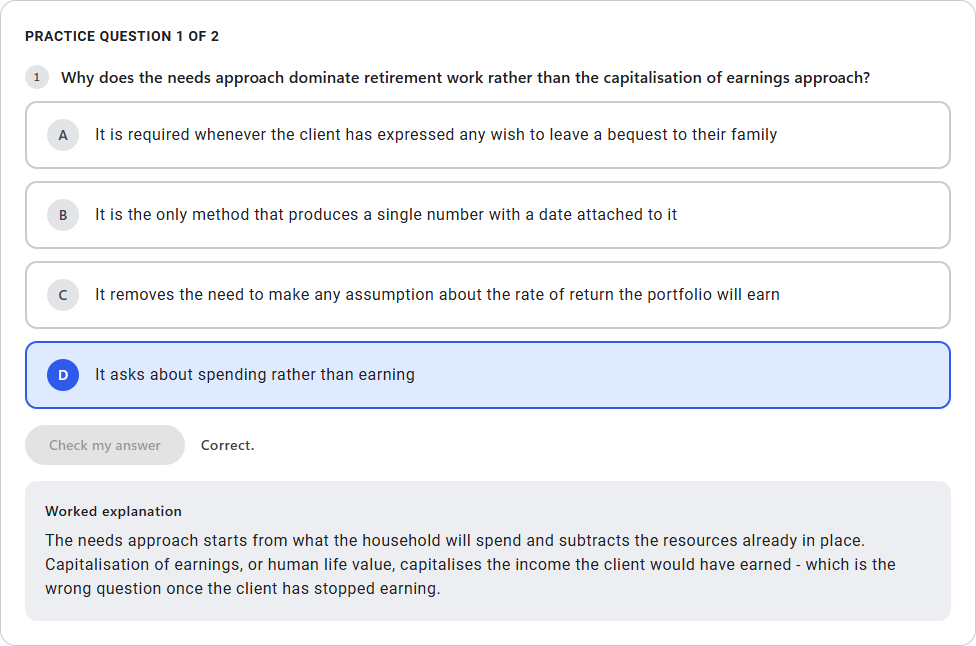
Our public sample lesson includes the recall question shown below. It explains the needs approach clearly, but it does not supply a client fact pattern. That is suitable for an early concept check; it would be too shallow as the main test of late-stage CFP readiness. Use the rest of this page to judge a full practice bank, including ours.
Test one: is there a client?
CFP Board says the exam tests applying planning knowledge in realistic situations. A late-stage question should give you enough information about a person or household that the answer depends on their circumstances. A term-definition check can still help when you first learn a topic; it is a weak proxy for readiness after you have covered the curriculum.
Look for facts that do work: time horizon, liquidity need, tax position, existing coverage, risk tolerance or a legal constraint. Remove one of those facts mentally. If the recommended answer would be identical, the stem may be decorative rather than analytical.
Test two: is more than one option defensible?
A planning case can offer several reasonable actions while asking for the best next step. One may solve a long-term goal but ignore a near-term liquidity problem. Another may be tax-efficient but unsuitable for the client's risk capacity. A useful explanation says which stated fact breaks the tie.
If the wrong options can be dismissed without reading the fact pattern, the question tests elimination more than planning judgment. It may still teach a rule, but a high score on it gives little evidence about case reasoning.
Test three: does the explanation argue against the near-miss?
The most useful sentence in a case explanation is often the one that explains why a plausible alternative loses here. Perhaps an insurance recommendation is reasonable in general but the client already has sufficient coverage. Perhaps an investment has a higher expected return but cannot fund the planned withdrawal. The explanation should point back to the client facts, not simply restate a textbook definition.
Try a blind review: after choosing, hide the marked answer and write one reason for your choice and one reason against the closest alternative. Then read the provider's explanation. If the explanation never addresses your near-miss, you have found the gap that your own notes must fill.
| Feature | Early concept check | Late-stage case practice |
|---|---|---|
| Question stem | Isolates one rule or definition | Supplies client facts that affect the action |
| Wrong options | Expose a basic misunderstanding | Remain plausible until you weigh the facts |
| Explanation | Defines the concept accurately | Explains the tradeoff and the near-miss |
| Best use | Soon after a lesson | During integrated review and timed practice |
Two further checks
- Which tax year is it written to? Figures and thresholds may change, so the question and explanation should name their assumptions.
- Does the bank include case sets? Practicing every item singly can miss the skill of extracting relevant facts from a longer case.
What to do with a mediocre set
Answer it, then write a short reason the nearest wrong option was tempting. Mark whether your error was missing a client fact, misreading the question's requested action, or not knowing a rule. Those are different problems and need different review. A fact-reading error calls for slower case annotation; a rule gap calls for returning to the source. A bank that never explains its near-misses forces you to supply that work yourself.
How to trial a bank before committing
Try a short sample across several knowledge domains. Include at least one integrated case, one calculation and one ethics or professional-conduct decision if the trial offers them. Read the wrong-answer reasoning even on items you got right. Check the date of any tax figures and whether the explanation names its source. A sample that offers only recall items may be useful for learning vocabulary, but it cannot demonstrate the quality of the provider's case practice.
Our screenshot above is deliberately an early concept check. It shows the feedback interface and a clear comparison of two approaches. It does not demonstrate the harder case skill this page recommends. That distinction is worth keeping in view when you evaluate any provider, including Sitonce.
Common questions
What makes a good CFP practice question?
A client fact pattern, more than one defensible option, and an explanation that says why the near-miss loses on those facts.
Are definitional questions useless?
They have a place early on. They should not dominate a bank you are using late in preparation.
What is wrong with obviously wrong options?
They test elimination rather than judgment, and inflate your score.
What else should I check?
The tax year it is written to, and whether questions come in case sets.
How do I use a weak question set?
Write your own one-line reason each wrong option was tempting. That supplies the missing half.