
 United States
 Hong Kong
What a Good PTCE Practice Question Looks Like
Judge a PTCE question by its explanation and its fit with the current outline.
- Federal rule questions should point to a current source, calculation answers should show units and steps, and wrong options should represent plausible mistakes rather than filler.
On this page6 sections
A score alone cannot tell you whether a question bank is worth studying. Read what happens after you choose an option. The answer page should teach you to solve a different question on the same topic, not merely show you the letter you missed.
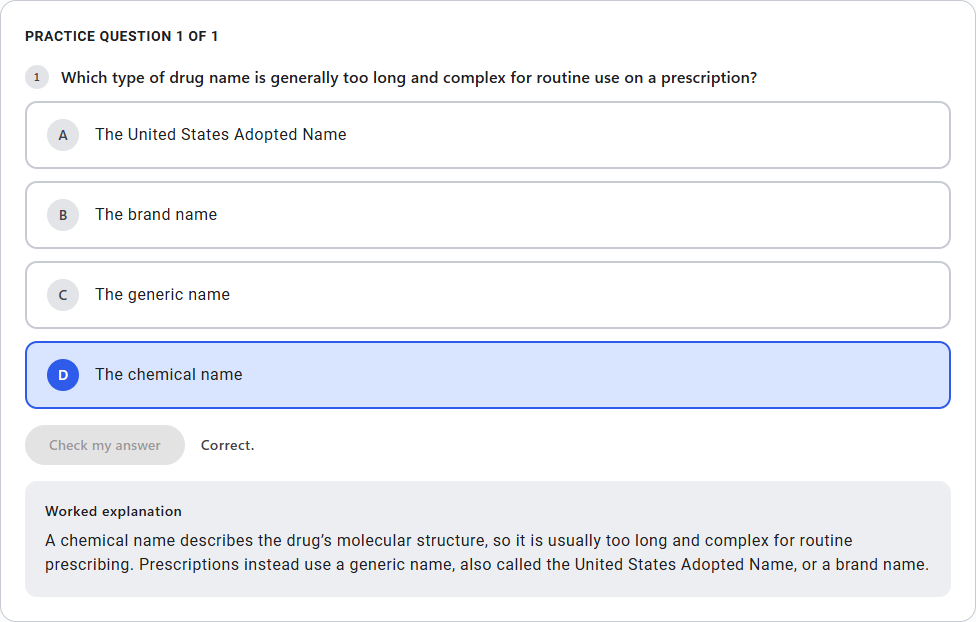
Our free sample lesson starts with a short drug-name check. It shows how the answer and explanation appear, but a single recall item cannot prove that a full bank handles calculations and federal rules well. Apply the tests below to several different question types before buying anything.
Test one: does the federal explanation cite the source?
The current outline assigns Federal Requirements a defined share of the scored exam. Those requirements can be checked in public regulations and agency material. An explanation that quotes a recordkeeping period without naming the rule is hard to verify; one that points to the relevant provision lets you check whether the requirement applies to the scenario.
Open the cited provision at least once. Check the exception and the subject of the rule, not just the number in it. A pharmacy scenario can also be affected by state law, so a federal citation alone may not settle every real-world question.
A provider can cite a copyrighted source without copying it. On the PTCE, public federal regulations make the citation especially easy to check. For a current legal question, look for a section number or direct link and a date of review.
Test two: are the wrong answers real mistakes?
On a calculation, the distractors should be the inverted conversion, the daily figure where a dose was asked, and the decimal place. On a controlled substance question, the rule from an adjacent schedule. Look it up yourself.
Options nobody would choose inflate your score and teach nothing. For example, if a days-supply problem says two tablets twice daily and the wrong option divides by two rather than four, that distractor reveals a specific mistake: confusing doses per day with tablets per day. If the explanation names that mistake, the item is useful even when you answered correctly by luck. Mark lucky guesses for review; they are not evidence of mastery.
Test three: does the calculation explanation show the working?
An answer in mL is not an explanation by itself. The working should show the conversion, the requested dose, the concentration on the label and the final unit. It should also explain why a tempting wrong answer arose. For practice, cover the numerical answer and see whether the explanation would still let you solve the next calculation.
Without the intermediate steps you cannot tell whether the error was in unit conversion, multiplication, or reading the label. That diagnosis is the main value of doing a practice calculation.
| What to inspect | Useful evidence | Reason to pause |
|---|---|---|
| A federal-rule item | Current provision named and applied to the scenario | Only an undated rule of thumb |
| A calculation | Units, conversion and intermediate steps shown | Only a final number or unexplained formula |
| A safety scenario | Explains why the near-miss is wrong | Other options are implausible |
| A timed mock | Domain mix tied to the current official outline | No outline version or date is disclosed |
Test four: is it weighted to the current outline?
A full-length set with almost no federal questions may be weighted to an older outline. Ask the provider which outline governs its mock and when it changed the bank. Isolated practice questions need not copy the exam mix, but a readiness mock should explain its weighting and limitations. Strong individual explanations can still produce a misleading readiness score if the set overrepresents a domain that shrank.
A fifth test, for scenario questions
On Patient Safety, the options should be plausible practices with one addressing the specific risk. If the other options are obviously absurd, the question tests elimination rather than judgment. There is another check: scope of practice. An item should let a technician recognize when a pharmacist must intervene rather than reward a guess about a clinical decision outside the technician's role.
Using a weak set
Look up federal answers yourself in the regulation. For calculations, write your own unit-by-unit solution. For brand and generic recall, make a card from each mistake but do not mistake recognition of a familiar option for recall. For safety scenarios, note the fact in the stem that made referral necessary. After a few questions you will know whether the set can teach you or merely grade you. If it only grades, use the official outline to find a better source of practice before paying for more of the same.
Common questions
What makes a good PTCE practice question?
A cited source for federal answers, distractors built from real errors, shown working on calculations, and current weighting.
Why does citation matter here?
A source citation lets you check whether a federal rule and its exceptions apply to the scenario. Citing copyrighted material is also possible; citation does not mean reproducing the source.
What is a good calculation explanation?
The steps, not the answer. Without them you cannot tell which step you got wrong.
What makes a good scenario distractor?
Plausible practice that addresses a different risk from the one in the stem.
How do I use a weak set?
Look the federal answers up in the regulation yourself.