
 United States
 Hong Kong
The SFC Code of Conduct, explained for Paper 1 candidates
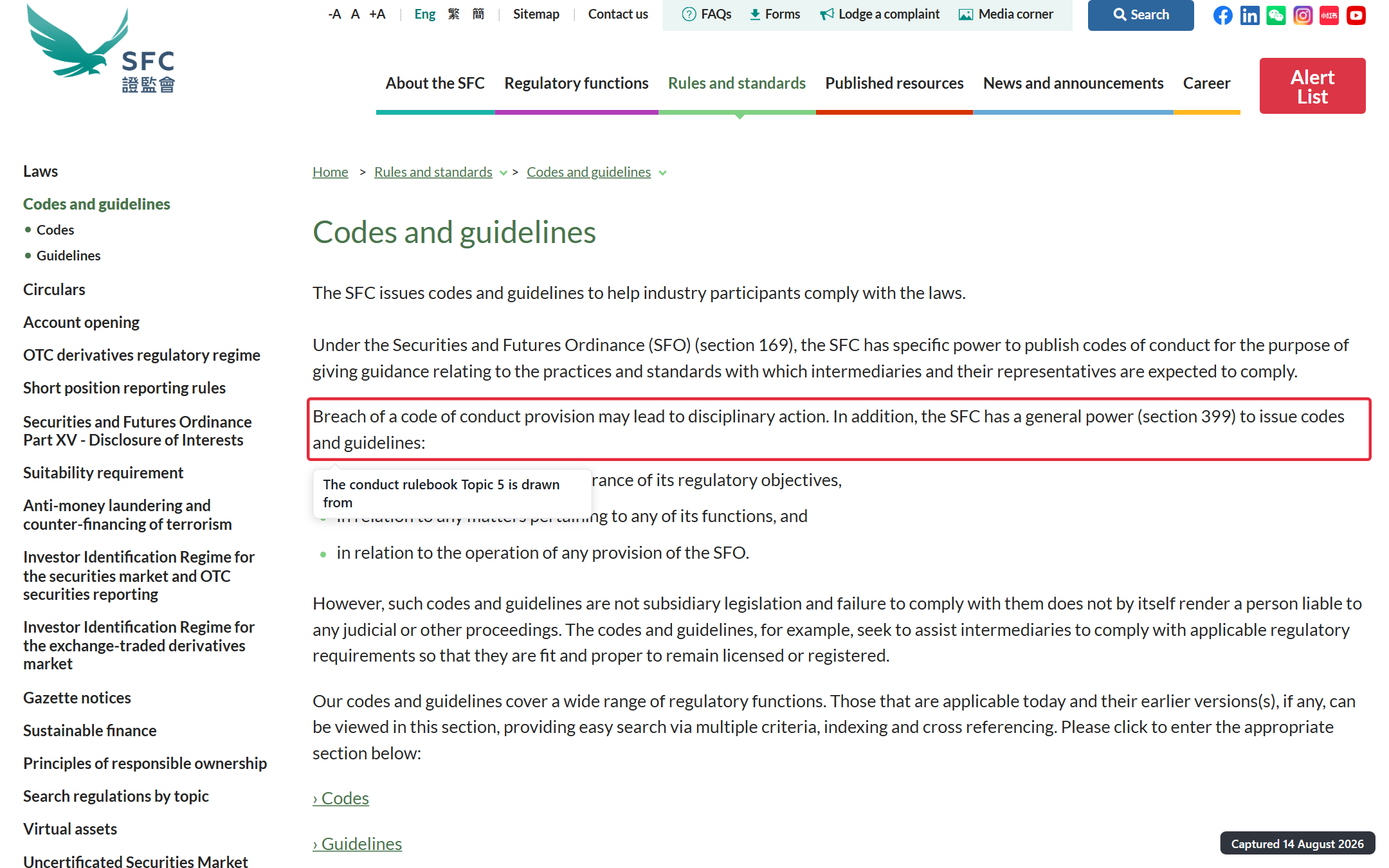
The SFC Code of Conduct sets the standards expected of licensed and registered persons in Hong Kong. It is not subsidiary legislation, so breaching it is not an offence, but the Ordinance lets non-compliance count against your fitness and properness. Nine General Principles sit at the front, followed by detailed paragraphs.
- Full name
- Code of Conduct for Persons Licensed by or Registered with the SFC
- Issued by
- Securities and Futures Commission
- Status
- Not subsidiary legislation; non-compliance goes to fitness and properness
- Structure
- Nine General Principles, then numbered paragraphs and schedules
- Applies to
- Licensed corporations, licensed representatives and registered institutions
Start with the status question, because everything else depends on it. The Code binds you without being law. The SFC issues it under its own powers, the Ordinance provides that a failure to comply may be taken into account in judging whether a person is fit and proper, and fitness is the thing that keeps your licence alive. So the Code is enforced through the licence rather than through the courts.
Candidates who memorise that one sentence pick up marks across the whole of Topic 5.
How is the Code of Conduct structured?
Two layers. At the front sit nine General Principles, written in a sentence each. Behind them run numbered paragraphs that put flesh on the principles, followed by schedules dealing with specialist areas such as professional investors and electronic trading.
The paper tests the principles by name and the paragraphs by substance. You are not expected to recite paragraph numbers, and a question that appears to require one is almost always testing the obligation instead.
What are the nine General Principles?
| Principle | The obligation in one line |
|---|---|
| Honesty and fairness | Act honestly, fairly, and in the best interests of clients and market integrity |
| Diligence | Act with due skill, care and diligence |
| Capabilities | Have and effectively employ the resources and procedures the business needs |
| Information about clients | Seek information on the client's financial situation, experience and objectives |
| Information for clients | Make adequate disclosure of relevant material information to clients |
| Conflicts of interest | Avoid conflicts; where unavoidable, ensure fair treatment |
| Compliance | Comply with all regulatory requirements applicable to the business |
| Client assets | Account for client assets promptly and safeguard them adequately |
| Responsibility of senior management | Senior management bears primary responsibility for standards and procedures |
The fourth and fifth principles are a mirror image of each other and they are the classic transposition error. About the client is inbound information. For the client is outbound. Under exam pressure people reverse them, lose the mark, and never notice.
What does the Code say about conflicts and client priority?
The hierarchy is simple. Avoid the conflict. If you cannot avoid it, disclose it and make sure the client is still treated fairly, because disclosure on its own does not always discharge the duty. That last qualification is the examinable part: a question that offers disclosure as a complete answer to a conflict is usually offering the wrong answer.
Client priority runs alongside it. A firm must not put its own interests, or those of its staff, ahead of a client's. Client orders go first. Deal for yourself in front of a client order you know about and you have moved out of the Code and into conduct that can be treated as market misconduct or an improper trading practice.
Best execution and handling complaints
Best execution means executing client orders on the best terms available. Note the wording. It is not a promise of the best price achieved in hindsight; it is an obligation about the terms reasonably available at the time, taking the whole execution into account.
Complaints have their own shape. Handle them promptly and diligently, investigate, and tell the client the outcome. Where the complaint is not remedied promptly, the firm must advise the client of the right to take the matter elsewhere. That final step is the one dropped in practice and the one questions like to isolate.
How does the Code treat professional investors?
As a tiered regime, not a switch.
- Institutional professional investors - banks, insurers, licensed corporations, governments and similar bodies. The widest set of waivers, available without a consent process.
- Corporate professional investors - companies qualifying on an assets basis. Fewer waivers, and only after the firm assesses them and follows the consent procedure.
- Individual professional investors - individuals qualifying on an assets basis. Fewer again, and the suitability obligation is not waived for them the way it can be for institutional clients.
The firm must assess, obtain written consent, explain the consequences of the treatment, and tell the client they may withdraw that consent. Skip any step and the waivers do not apply.
What happens when a firm breaches the Code?
Not a prosecution. The SFC can discipline the firm or the individual, and the consequences run through the licence: reprimand, conditions, suspension, revocation, and a finding that bears on whether you remain fit and proper. A pecuniary penalty is available in the disciplinary regime, but the figures move and you should read them from the current legislation rather than from a study note.
"Breach of the Code of Conduct is a criminal offence" is wrong every time it appears. So is "breach of the Code has no consequences because the Code is not law". The right answer sits between the two.
An opinion about how to study it
Read the Code once, properly, from the SFC site. It is shorter than you expect and the language is plainer than the textbook summaries of it. Most candidates never open the primary source and instead learn a paraphrase of a paraphrase, which is exactly how the fourth and fifth principles end up swapped. One careful read, then question practice, beats three passes through a revision deck.
The concession: the specialist schedules genuinely are dry, and skimming them is defensible if you are short of time. Just do not skim the client agreement content or the professional investor tiers. Those two carry a disproportionate share of the questions in Topic 5 practice sets.
Common questions
Who does the SFC Code of Conduct apply to?
Licensed corporations and licensed representatives, and registered institutions carrying on regulated activities. It applies to the individuals as well as the firm, which is why a representative can be disciplined personally for conduct their employer permitted.
Is breaching the SFC Code of Conduct a criminal offence?
No. The Code is not subsidiary legislation, so a breach is not in itself an offence. It exposes you to SFC disciplinary action and counts against your fitness and properness, which can end in suspension or revocation of the licence.
What is the difference between a General Principle and a Code paragraph?
The nine General Principles state the standard in a single sentence each. The numbered paragraphs behind them set out detailed requirements that give effect to those principles, covering matters such as client agreements, order handling, complaints and professional investors.
Can a client agreement exclude the suitability obligation?
No. The client agreement must contain a suitability clause and a statement that no other provision of the agreement, and no statement made by the firm, derogates from it. A disclaimer that purports to exclude suitability is ineffective.
Does the Code apply differently to professional investors?
Yes, in tiers. Institutional professional investors attract the widest waivers. Corporate and individual professional investors attract fewer, and only after the firm assesses them, obtains written consent and explains the consequences. Suitability is not waived for individual professional investors in the same way.